From Game Boy to Cyanotype
The printer's art facing the pixel challenge
by Thierry Chabanis
A collaboration with Thierry Chabanis
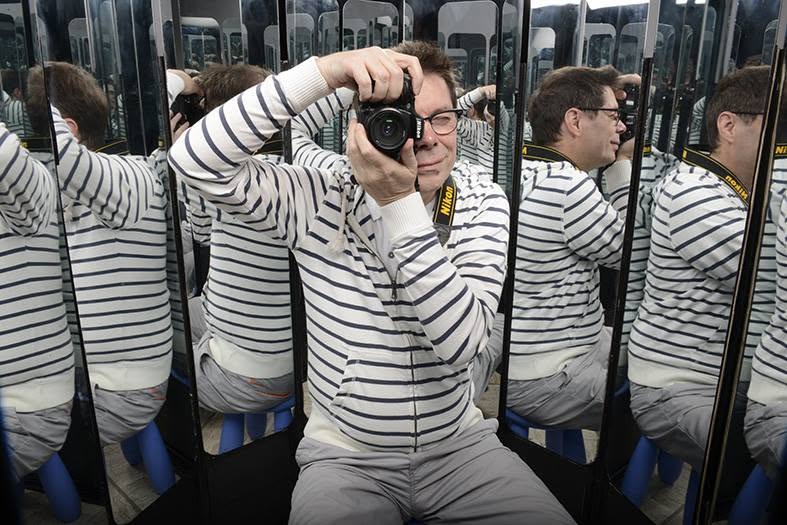
Pierre BanwarthOriginal Game Boy Camera photographs
Thierry ChabanisArtist behind the cyanotype prints, their creation and interpretation
This cyanotype print project simply would not have come to life without Thierry Chabanis's longstanding passion for photography and his expertise in this process.
Beyond the photographic work, it is also a family story, a declaration of love between a godfather and his godchild, brought together by shared curiosities and interests.
I thank him for always nurturing my curiosity, for passing on his love of experimentation, and for so many other things.
Being able to share ideas, passions and projects with family is a wonderful gift.
Thank you, godfather.
Why is the print the soul of photography?
In the collective imagination, photography is often reduced to a single instant: the click of the camera. Yet the captured image is only raw material, a silent score waiting to be interpreted. It is in the dim light of the darkroom, or in front of the development screen, that the real metamorphosis takes place. The printer is not a mere technical executor; he is the craftsman of shadow, the interpreter who breathes in an atmosphere, sculpts the light and gives a physical body to a fleeting vision.
This reflection takes on its full meaning with the most extreme projects, where technology seems to impose its limits. Recently, I was faced with a singular challenge: bringing to life images captured with a Game Boy Camera from the 1990s. It is through this dialogue between raw technical constraint and the alchemy of a historical process that the approach presented below was born. Proof, in blue, that the truth of a photograph lies as much in the hand that reveals it as in the eye that captured it.
When the pixel meets Prussian blue
The Game Boy challenge
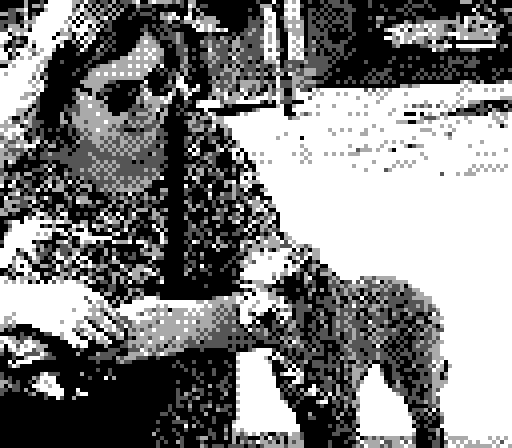
When Pierre Banwarth entrusted me with images taken with a Game Boy Camera, I faced a dizzying challenge. This console produces tiny files (128 pixels wide) for prints the size of a postage stamp, and has only four levels of grey. To fake gradients, it uses geometric patterns, a sort of mosaic of dots. Using my usual printer's tools, such as shading or light masks, was impossible here. I had to find another way to give a soul to this raw digital material.
The alchemy of cyanotype
Instead of fighting the limits of the Game Boy, I suggested to Pierre that we sublimate them with cyanotype, a historical photographic process from the 19th century. Cyanotype is known for its difficulty in rendering smooth gradients, but it excels at reproducing strong contrasts. It was the perfect setting: its shades of blue would welcome the console's four levels of grey with absolute fidelity, turning a cold computer file into an organic, material work.
A play of optics and distance
The second bold choice was to transform the size of the image by enlarging it to A3 format. This change of scale unsettles the viewer and invites them to move:
- −Up close, the image disappears to make way for an abstract mosaic of big pixels and textures.
- −From afar, stepping back, the magic happens: the dots blend into one another, details merge, the illusion works and the scene reveals itself to the viewer.
Through this printing work, the Game Boy of yesteryear becomes a living artistic experience.
From pixels to sunlight: the recipe for a timeless print
- Digital Game Boy image
- Enlargement & negative
- Light-sensitive paper & sun exposure
- Physical cyanotype print
How do you go from a virtual image stored on a game console to a large print of deep blue? Here is the behind-the-scenes of my work as a printer, a bridge between digital nostalgia and 19th-century alchemy.
Preparing the magic potion
It all begins in the dim light of the workshop. I prepare the light-sensitive solution by mixing two chemicals (ferric ammonium citrate and potassium ferricyanide). With a brush, I delicately spread this yellow-green liquid onto thick watercolour paper. This paper is chosen for its grain and its ability to withstand the water baths to come. Once spread, I let the paper dry away from light: it is now ready to react to the sun's rays.
Preparing light-sensitive paper
Thick watercolour paper has been previously prepared and sensitized. Each sheet must be treated carefully, in even layers of light-sensitive solution. The paper is then left to dry completely away from light, ready for the next steps in the process.
Digital image processing
While the paper dries, I work on the Game Boy file. To go from the size of a postage stamp to A3 without the image becoming blurry and unreadable, I extrapolate the pixels digitally. I take care to preserve the perfect sharpness of each little original square.
Creating the negative
Cyanotype is a contact process: the negative must be the same size as the final print. So I invert the colours of my A3 image on the computer (white becomes black, light greys become dark) and print the result on a transparent film, similar to tracing paper. We have just recreated a negative, essential to this craft technique.
Exposure and development
I place my coated (now sensitive) watercolour paper on a table. I lay the printed film directly on top, and press the whole thing under a pane of glass. I then expose this "sandwich" directly to the sun's rays. Where the film is transparent, the UV rays pass through and "cook" the paper. Where the film has big black pixels, the light is blocked.
After a few minutes of exposure, I immerse the paper in a tub of clear water. This is the most magical moment: the chemistry that has not seen the light dissolves and washes away, while the areas struck by the sun fix and instantly turn a vibrant Prussian blue. The Game Boy's four levels of grey are now engraved in the paper's fibres.
Original Game Boy Camera photographs: Pierre Banwarth
Texts: Thierry Chabanis
Cyanotype prints, creation and artistic interpretation: Thierry Chabanis
Collaborations & Orders
Interested in cyanotype prints?
For exhibitions, collaborations, or inquiries about the work, get in touch.
Get in Touch ->